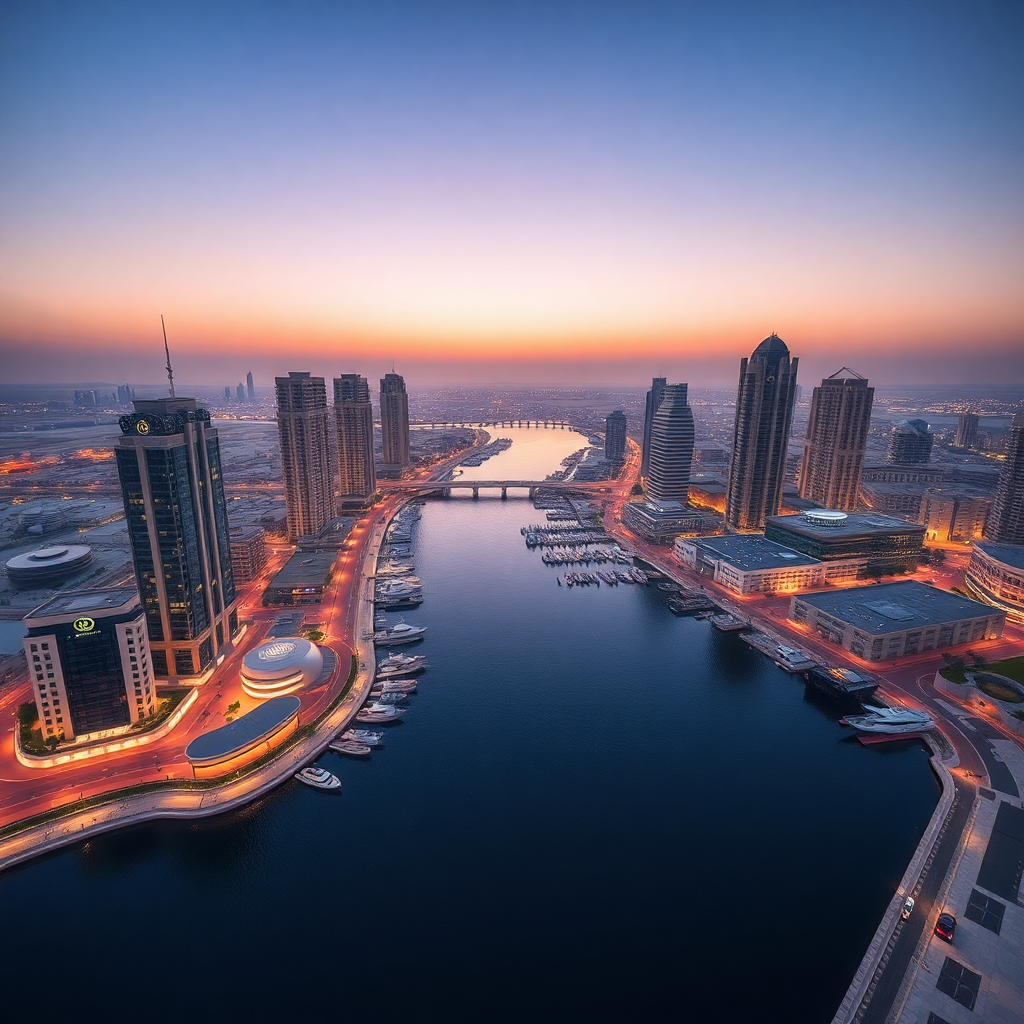
This is a composite case study of a private investor. The calculations are provided as examples, while the market statistics come from publicly available reports by DXBinteract, CBRE, Knight Frank and RAKTDA.
I arrived in Dubai with a fairly standard plan: buy a one-bedroom apartment, rent it out and earn an assumed 7—8% a year.
The plan seemed as straightforward as possible. An apartment is an apartment: people always need somewhere to live, finding a tenant is relatively easy, and Property Finder lets you check prices quickly.
Then I was shown a small fitted office. The price was around AED 2 million, with potential annual rent of AED 200,000.
On the presentation, everything looked perfect:
200 000 / 2 000 000 × 100% = 10% годовыхAt that point, it is easy to decide that residential property is for conservative investors, while commercial property is for people who know how to calculate returns.
In practice, things turned out to be slightly more complicated.
Why I considered commercial property in the first place
I did not want to buy an office just because a broker wrote on WhatsApp: ROI up to 10%.
First, I looked at what was happening in the market.
According to DXBinteract, Dubai recorded 1,212 commercial property transactions worth AED 3.6 billion in the first quarter of 2025. The value of sales increased by 25.2% compared with the same period in 2024.[1]
By the end of 2025, the median rent for new commercial lease contracts had reached AED 120,000—14.29% higher than a year earlier.[2]
The office segment was even more interesting. CBRE estimated average office occupancy in Dubai at around 95%, while rents increased by 18% during 2025.[3]
In other words, commercial property was not growing only in polished renderings. Companies were genuinely looking for premises, the supply of vacant high-quality offices was shrinking, and rents were rising.
But the market was growing very unevenly.
According to Knight Frank, the average office price in Downtown Dubai rose by 29% in 2025, reaching AED 5,130 per square foot.[4] At the same time, demand was concentrated in high-quality buildings, efficient layouts and locations close to the metro.
An office in a good tower and an office in a building with three slow lifts are effectively two different products.
My 10% quickly became 6.7%
Suppose I bought an office for AED 2 million and rented it out for AED 200,000 a year.
The marketing presentation shows a 10% return. Then real life begins.
In addition to the office price, I pay the registration fee, the broker’s commission and transaction costs. The total acquisition cost comes to approximately AED 2.13 million.
142 300 / 2 130 000 × 100% = 6,68%That is no longer a magical 10%, but it is still a reasonable result.
The main difference from an apartment is this: if I find a stable business, it may stay for several years.
A company spends money on fit-out, furniture, internet, partitions and registering its address. Moving is more difficult for a business than changing apartments is for a residential tenant.
But the reverse is also true. If the business closes, the office may remain vacant for several months. A residential apartment usually has a much wider pool of potential tenants.
Commercial property therefore generates more income not because it is “better.” It pays the investor a premium for taking on a more complex risk.
What I would buy in Dubai
After reviewing the market, I stopped looking simply for an “office with a high ROI.”
I looked for premises that I would be willing to rent for my own business.
My filter looked like this:
- no more than a 10—12-minute walk to the metro;
- at least one parking space;
- completed fit-out;
- a practical rectangular layout;
- reasonable service charges;
- functioning lifts;
- the ability to register a company;
- a price that a small business could afford.
By this logic, Business Bay and JLT made the most sense to me.
Business Bay is more liquid and prestigious, but the difference between buildings within the district is enormous. In one tower, an office is rented quickly; in the neighbouring one, tenants have complained about parking and lifts for years.
JLT is often cheaper and works well for small trading, IT and consulting companies. But there too, you cannot buy based solely on the price per square foot.
Dubai South looks more interesting as a long-term bet: Al Maktoum Airport, Expo City, logistics and new residential districts. But it is not a market where I would count on immediate cash flow.
I prefer Dubai Creek Harbour for neighbourhood retail: cafés, pharmacies, salons, clinics and everyday services. For a conventional office, the district is still less obvious than Business Bay or JLT.
I would be more cautious with a shop
Retail property can indeed generate a gross yield of around 8—10%. But a shop unit is more complicated than an office.
I could buy an attractive ground-floor unit and then discover that:
- it cannot be seen from the road;
- there is nowhere nearby to park;
- proper signage cannot be installed;
- there is no extraction system for a restaurant;
- the electrical capacity is insufficient;
- people enter the building through another entrance.
In residential property, a poor view can be offset by the price. In retail, a lack of footfall sometimes cannot be offset at all.
That is why I would buy a shop only after visiting it several times at different times of day. It is better to literally stand nearby and count how many people walk past.
What about Ras Al Khaimah?
Ras Al Khaimah looks tempting: entry prices are lower, while resorts, hotels and branded residences are being developed around Al Marjan Island and Mina Al Arab.
But commercial property there is a riskier bet.
In 2025, Ras Al Khaimah welcomed 1.35 million tourists, 6% more than a year earlier. Tourism-sector revenue increased by 12%.[5]
At the same time, RAKEZ registered 8,506 new companies in the first half of 2025 alone—43% more than a year earlier.[6]
These are positive signals for offices, warehouses, restaurants and service retail.
But there is a problem: the Ras Al Khaimah market is smaller and less liquid. Detailed statistics on commercial transactions are harder to find, and tenant demand depends more heavily on the individual project.
In Dubai, I am buying premises within an economy that already exists. In Ras Al Khaimah, I am more often buying an expectation of what the economy may become in several years.
That is why I would consider only very clear formats there:
- a small retail unit in an already occupied neighbourhood;
- premises close to operating hotels;
- a warehouse or office with a tenant already in place;
- a hotel unit with a transparent management agreement.
I would not buy an empty shop simply because a major resort may open nearby one day.
An apart-hotel is not an apartment with extra benefits
I was also offered an apartment in a hotel project with a promised return.
But an apart-hotel is a separate business.
Income depends on:
- occupancy;
- room rates;
- the operator’s commission;
- operating expenses;
- revenue-sharing terms;
- restrictions on personal use.
You need to check separately what is stated in the title deed: a regular apartment, a serviced apartment or a hotel apartment.
The phrase guaranteed return does not solve the problem either. The guarantee applies for a limited period, and the return may change once it ends.
My conclusion after doing the calculations
I do not believe commercial property is automatically more profitable than residential property.
It becomes more interesting when I understand three things:
- Who my tenant will be.
- Why they will choose this particular space.
- How much money will remain after all expenses.
An apartment is simpler and more liquid. Commercial property is more complex, but a good choice can provide more stable cash flow and a longer lease.
The most dangerous mistake is to buy premises with a projected 10% return and only then start wondering who might actually need them.
Now I look not at the promised ROI, but at the premises through the tenant’s eyes.
If I cannot understand what kind of business could operate there, then I am not buying an investment. I am buying an expensive empty room.
---
Sources
[1]: DXBinteract: Dubai property market in the first quarter of 2025
[2]: DXBinteract: Dubai market year-end report for 2025
[3]: CBRE: UAE Real Estate Market Review Q4 2025
[4]: Knight Frank: Dubai Office Market Review H2 2025
[5]: Ras Al Khaimah Tourism Development Authority: 2025 tourism results
[6]: CBRE: Ras Al Khaimah Real Estate Market Review Q2 2025
This material is provided for informational purposes only and does not constitute individual investment, legal or tax advice. The yield calculation shown is an illustrative model, not the result of a specific transaction.

Vlad Muravyev
Real estate market analyst
Specializes in UAE property investment, international education, and visa support. Helps clients from Russia, the CIS, Africa, and China find the right solutions.